Pocahontas was twelve years old when history was
changed by the arrival of three English ships to the new
world. The Englishmen on the ships came to start a new
colony. The new colony was Jamestown. One of the
Englishmen who came to the new world was John Smith.
John Smith canoed up a river one day. He was going to an
Indian village to attack them. The Indians captured him
and sent a message to the chief of all the little villages,
(Powhatan, Pocahontas' father -- Chief of the Algonquin Nations) telling him they were
going to bring an Englishmen the next day. Pocahontas
was excited because she had never seen a white man
before.
The next day Pocahontas dressed in her nicest clothes.
When the Indians came with John Smith, Pocahontas saw
him and thought that he was the most handsome man she
had ever seen.
The Indians told Powhatan that John Smith had killed two
of their braves with fire sticks. John Smith said that the
Indians had killed two of his men first. Powhatan told John
Smith to be quiet and said that he would be killed for the
Indian braves' lives. The next day the Indians put John
Smith's head on a stone. Powhatan was about to kill John
Smith when Pocahontas ran to John Smith and put her
head on top of his. She yelled, "I claim John Smith!"
The following is John Smith's own account of this incident, written by him in his "General Historie" published in 1624:
"Having feasted him . . . A long consultation was held, but the
conclusion was, two great stones were brought before Powhatan:
then as many as could lay hands on him, dragged him to them, and
thereon laid his head, and being ready with their clubs, to beate out
his braines, Pocahontas the Kings dearest daughter, when no intreaty
could prevaile, got his head in her armes, and laid her owne upon
his to save him from death: whereat the Emperour [Powhatan] was
contented he should live to make him hatchets, and her bells, beads,
and copper . . ."
Powhatan could not kill John Smith because he was now
Pocahontas'. Powhatan explained that John Smith was
owned by Pocahontas and had to stay with Pocahontas in
their village. John Smith said he understood and Powhatan
let him go. The time that John Smith was in Powhatan's
village he and Pocahontas became good friends.
One day some braves took John Smith to a hut. A day
after he was put in the hut Powhatan came with 200
Indians. He was painted in black war paint. He said, "John
Smith, now that my daughter has claimed you I have
decided to adopt you." After he said this he gave John
Smith his equipment and told him to go back to
Jamestown.
When winter came Pocahontas worried about John Smith
so she asked her father if she could take food to the
Englishmen. Powhatan thought that the tribe had enough
food for the winter, and extra, so he decided to let her.
Pocahontas took many young girls with baskets of corn on
their backs. When they got to Jamestown the huge doors
opened and a man stepped out with a gun over his
shoulder. All the girls ran leaving the baskets behind.
Behind the first man came another man, it was John Smith.
Pocahontas was so happy to see him. After staring at John
Smith for a while she said they had brought enough food
to last the winter. John Smith thanked Pocahontas and she
ran home.
After that Pocahontas visited Jamestown often until
Powhatan banned her from Jamestown. Pocahontas
started to cry as she asked, "Why?" Powhatan said that
more Englishmen were moving to the Island and taking
over his villages. He also said something very important. He
said that they were going to give a lot of food to the
Englishmen for a feast and while the Englishmen were
eating they would attack them. Pocahontas ran off crying
after he finished.
That night she sneaked over to the John Smith's camp by
the river and woke him up (they were camping there
because they traded with Powhatan's village). They
wanted to leave but they couldn't because of the high
tide). Pocahontas was crying as she told him everything
her father told her.
The next day the Indians brought food just like Pocahontas
told John Smith. But even before the Indians came John
Smith and his men had already set sail because the tide
had gone. A couple of weeks after this John Smith was
wounded by a gun powder explosion and went back to
London. Pocahontas was disappointed.
One night Powhatan took some braves to Jamestown and
captured two Englishmen and took their guns from their
tent. When Pocahontas found out she was even more
disappointed than she was already. She had to talk to
someone, so she went to another Indian village and talked
to the chief there (she knew the chief). She talked to the
chief about what had been happening and how she felt
about it. After Pocahontas left, some Englishmen in canoes
came to the chief with a huge copper pot. The
Englishmen told the chief that he would trade the pot for
Pocahontas. The Englishmen explained that if they had
Pocahontas then maybe Powhatan would trade the
captured Englishmen for Pocahontas. The chief agreed to
the offer. He said he would tell Pocahontas that he was
going to take her to the English ship for a tour and leave in
his canoe.
The next day the chief went to Powhatan's village and
found Pocahontas. Pocahontas went with the chief in his
canoe to the ship. When Pocahontas went into the
captain's office, the chief got back in his canoe and left
Pocahontas on the ship.
The English leader sent a message to Powhatan saying that
he had to give the Englishmen back their weapons and set
them free or he would never see his daughter again.
Powhatan sent the Englishmen but not their weapons. So
the English kept Pocahontas.
While Pocahontas was in Jamestown she learned the
English language -- she became the first Native American in America to convert
to Christianity. She was baptized an Anglican and given the name
Rebecca. When Pocahontas first arrived
in Jamestown John Rolfe saw her and fell in love instantly.
Pocahontas fell in love with him too and they became
more in love as they knew more about each other. In 1614
John Rolfe and Pocahontas were married. This brought
peace between the English and the Indians.
(As far as we can determine, Pocahontas was 19 at this time. NOT a "child-bride").
In 1615 more happiness came to Pocahontas and John
Rolfe. Pocahontas had a son. They named him Thomas. A
little while after Thomas was born John Rolfe had to go to
London on a business trip. He took Pocahontas and
Thomas with him and showed them almost all of London.
Pocahontas met the king and queen and after she did,
she became homesick. John Rolfe had to stay in London a
week longer and then they would go home.
When they were sailing home they had to stop in a town
close to London because Pocahontas was sick and had to
see a doctor. The doctor said that Pocahontas had small
pox and would surely die. She did died and was buried in
the town they stopped in. She was only 22 years old.
According to Native American lore, her parents knew her as
"Amonte" and her secret clan
name was "Matoaca." Her
European Christian friends
called her "Lady Rebecca."
Many have revered her as the
"mother" of our nation, the
female counterpart to George
Washington. Her face is on the Official Flag of Henry County, Virginia and the Official County Seal.
John Rolfe went back to Jamestown and had Thomas live
with a family that lived in the forest. When Thomas grew up
he moved back to Jamestown and married an English
woman. By that time his father had died.
Thomas later moved to England, where he finished his education. He later returned to his
mother's homeland, became a militia officer and commanded a
frontier fort in western Henrico on the James River.
NOTE: This page was copied (and edited only slightly) from a student who did it for a class project. All I know of the student's name is that she is "Kiara", and she was a 5th Grade student at Millville Elementary School, somewhere in Utah. Thanks, Kiara, whoever you are! I hope you got an "A+", and your teacher gets credit for an excellent job! I tried to write to you and to your teacher, but the e-mail link didn't work...

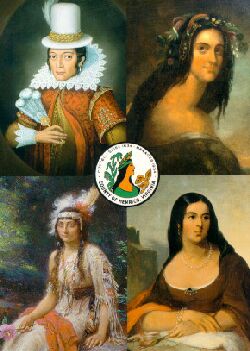 The Four Images of Pocahontas (From the Virginia State Archives)