| THE SECOND MILLENIA |
| AD 1000 -- AD 2000 |
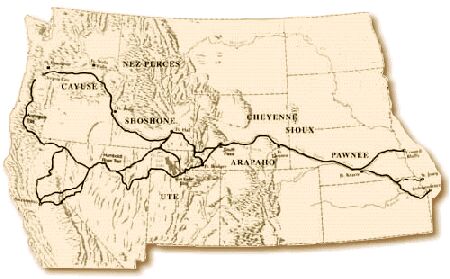 The Oregon Trail, 1843 (Note: Mormon Trail goes into Utah, California Trail splits from Oregon Trail at Ft. Hall, Wyoming
1843: The Oregon Trail
A Long, Strange Trip
Excerpts from a memoir: Tough times on the Oregon Trail
The Oregon Trail, stretching for roughly 1,900 miles, from Independence, Missouri, through Nebraska, Wyoming, Idaho and to the northern reaches of Oregon, was the route for thousands of fur traders, missionaries, and settlers. At the height of the migration west, in 1843, Indians, weather, and rattlesnakes posed threats -- but the deadliest threat was cholera.
For many years during the 1840's, large parts of the trail through Wyoming were shared by the Mormon Trail, which members of the Church of Latter Day Saints used to make their way to Utah. The trail branched in several new directions after the Gold Rush of 1849.
Historian Francis Parkman, who traveled the Oregon Trail at the height of the migration, wrote memoirs of his journey. Here are some excerpts:
Looking back...upon Fort Laramie and its inmates, they seem less like a reality than like some fanciful picture of the olden time; so different was the scene from any which this tamer side of the world can present. Tall Indians, enveloped in their white buffalo robes, were striding across the area or reclining at full length on the low roofs of the buildings which inclosed it. Numerous squaws, gayly bedizened, sat grouped in front of the room they occupied, their mongrel offspring, restless and vociferous, rambled in every direction through the fort...We were met at the gate, but by no means cordially welcomed...he signed to us that we had better fasten our horses to the railing; then he walked up the steps, tramped along a rude balcony and, kicking open a door, displayed a large room, rather more elaborately furnished than a barn. For furniture it had a rough bedstead, but no bed; two chairs, a chest of drawers, a tin pail to hold water and a board to cut tobacco upon. A brass crucifix hung upon the wall, and close at hand a recent scalp, with hair a full yard long, was suspended from a nail.
I was so reduced by illness that I could seldom walk without reeling like a drunken man, and when I rose from my seat upon the ground, the landscape suddenly grew dim before my eyes, the trees and lodges seemed to sway to and fro, and the prairie to rise and fall like the swells of the ocean. Such a state of things is not enviable anywhere. I sometimes suffered the extremity of exhaustion, and was in a tolerably fair way of atoning for my love of the prairie by resting there forever...I bethought me of starvation...I used to lie languid and dreamy before our tent, musing on the past and the future and when most overcome by lassitude, my eyes turned always toward the distant Black Hills. There is a spirit of energy in mountains, and they impart it to all who approach them. At that time I did not know how many dark superstitions and gloomy legends are associated with the Black Hills in the minds of the Indians.
Sometimes we passed the grave of one who had sickened and died on the way. The earth was usually torn up, and covered thickly with wolf tracks. Some had escaped this violation.
It is worth noticing that on the Platte one may sometimes see the shattered wrecks of ancient claw-footed tables, well waxed and rubbed, or massive bureaus of carved oak. These, some of them no doubt the relics of ancestral prosperity in the colonial time, must have encountered strange vicissitudes. Brought, perhaps originally from England, then with the declining fortunes of their owners, borne across the Alleghenies to the wilderness of Ohio or Kentucky, then to Illinois or Missouri, and now at last fondly stowed away in the family wagon for the interminable journey to Oregon. But the stern privations of the way are little anticipated. The cherished relic is soon flung out to scorch and crack on the hot prairie.
