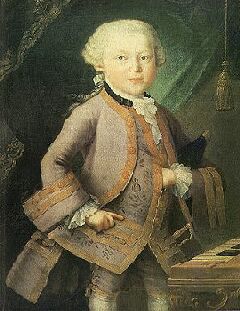
Probably the greatest genius in Western musical history, Wolfgang Amadeus Mozart was born in Salzburg, Austria, Jan. 27, 1756, the son of Leopold Mozart and his wife, Anna Maria Pertl. Leopold was a successful composer and violinist and assistant concertmaster at the Salzburg court, whose archbishop, Sigismund von Schrattenbach, encouraged the activities of Leopold and his remarkable children.
Wolfgang began composing minuets at the age of 5 and symphonies at 9. When he was 6, he and his older sister, Maria Anna, embarked on a series of concert tours to Europe's courts and major cities. Both children played the keyboard, but Wolfgang became a violin virtuoso as well.
In 1762, when Wolfgang was six, the Mozart children played at court in Vienna; the Empress Maria Theresa and her husband, Emperor Francis I, received them cordially. Later the Mozart children displayed (1763-66) their talents to audiences in Germany, in Paris, at court in Versailles, and in London (where Wolfgang, at the age of eight, began writing his first symphonies, and was befriended by Johann Christian Bach, whose musical influence on Wolfgang was profound). In Paris the young Mozart published his first works, four sonatas for clavier with accompanying violin (1764). In 1768, as he was now twelve, he composed his first opera, La Finta Semplice, for Vienna, but intrigues prevented its performance, and it was first presented a year later at Salzburg. In 1769-70, Leopold and Wolfgang undertook a tour through Italy. This first Italian trip culminated in a new opera, Mitridate, re di Ponto, composed for Milan. In two further Italian journeys he wrote two more operas for Milan, Ascanio in Alba (1771--he was now fifteen) and Lucio Silla (1772).
In 1772, Archbishop von Schrattenbach died, to be succeeded by Hieronymus von Colloredo, who retained Wolfgang as Concertmaster -- Wolfgang was now sixteen. In this capacity Mozart composed a large number of sacred and secular works. Wishing to secure a better position outside Salzburg, he obtained permission to undertake another journey in 1777. With his mother he traveled to France, where he composed the Paris Symphony (1778)
Mozart excelled in every form in which he composed. His contemporaries found the restless ambivalence and complicated emotional content of his music difficult to understand. Accustomed to the light, superficial style of rococo music, his aristocratic audiences could not accept the music's complexity and depth.
His music informed the
work of the later Haydn and
of the next generation of
composers, most notably
Beethoven. The brilliance of
his work continued until the
end, although darker
themes of poignancy and
isolation grew more
marked in his last years,
and his compositions
continue to exert a
particular fascination for
musicians and music
lovers.
His early musical genius is well documented: His father wrote in his diary that the first piece of music Wolfgang tried to play, a scherz was totally mastered by the five year old in thirty minutes. That was the average time it took him to learn all compositions, until at the age of six his father made the first note of Wolfgang's own composition. In the last years of his life, he wrote four operas in less than seven weeks. His genius never flagged.