1958: "Cat On a Hot Tin Roof" was drawing crowds to cool theaters. Teens were sock-hopping to Chuck Berry's "Johnny B. Goode."
But 34-year old electrical engineer Jack St. Clair Kilby didn't have time for movies and music. He was in a Texas Instruments laboratory in North Dallas, Texas, changing the world, inventing the future.
In July, 1958, the whole of TI was shutting down for the company's traditional two-week summer break. But new employee Kilby didn't have any vacation time accrued, so he stayed behind and worked.
Worried he'd be sentenced to work on a project he didn't care for, the engineer was determined to come up with something better.
He first identified the problem: current electronics technology was too unwieldy, too cumbersome and too expensive. How to make it smaller and more cost-efficient?
Each morning, Kilby folded his 6-foot 6-inch self into his '53 Ford and drove 3 1/2 miles north to T.I Headquarters.
In TI's quiet, brown-walled semi-conductor lab, the methodical Kilby set to work. He spent a lot of time thinking, reading, sketching, thinking some more -- what he describes as "a normal engineering" approach. You think about a problem very broadly at the beginning and then as you get a specific idea, it narrows down." He eventually thought of cutting into a single slice of semiconductor material all the components of an electronic circuit" transistors, resistors, and a slew of other "ors".
He wrote ideas in his lab book. He drew sketches. When his boss returned from vacation, Kilby brought out his notebook sketches. His boss was less than thrilled, but ultimately agreed to let Kilby build a test unit.
Kilby worked hours and hours, even weekends, to produce a working model.
In September, 1958, before a group of executives and engineers, Kilby unveiled his work: an integrated circuit, a microchip.
It was the bit that's made its way into, well, everything electronic: personal computers, phones, microwaves, cell phones, satellites, modern cars.
The future was born.
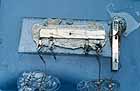 The First MicroChip
A few months later, a Californian was pursuing a similar end. Robert Noyce worked on a silicon chip using a process that became the standard. But Kilby was first. The two were content to share the honor of being the Men Who Changed The World. They left the picky details to the snigglings of corporate law.
Both men are revered in the engineering world. They are to pocket-protector devotees what Babe Ruth is to baseball.
And Kilby, the man who rocked the world with a nip of a chip small as your fingernail is a modest man living in a modest home in a modest subdivision in Dallas -- the same house he lived in when he built the first chip in 1958. "Moving was too much trouble", he says.
UT School of Engineering Dean Ben Streetman says no other invention changed the world as much as this one did.
EDITOR'S NOTE: I had the wonderful opportunity to meet and to know Robert (Bob) Noyce. When I attended his funeral his wife said that he was so unassuming, and so modest, that she would never even know that Bob had done something amazing -- created another amazing invention -- unless she read it in the paper!

